
How to Search the Murray County Court Docket
Start by reading the court name on the actual document. That single detail tells you which Murray County office holds the case. The Georgia Courts E-Access directory sends Murray Superior Court users to PeachCourt. An account is required before any search tools appear. PeachCourt is not a shared index for every Murray County court docket, though. Probate Court handles county traffic. Magistrate covers small civil claims and warrants. Juvenile restricts access, and each municipal court runs its own citation route.
- Identify the court, case type, and county or city on the notice.
- Copy the full case or citation number, filing year, and party name exactly.
- Use Georgia E-Access for Superior Court, or the named lower-court office or city portal.
- Read the case header, dated entries, newest setting, and disposition as separate fields.
- Call the record custodian when a portal is gated, incomplete, or returns no result.
Empty results are not the last word. A Murray County case can still exist under a different spelling, a set of initials, or another court class. Consider city versus county jurisdiction too, plus transmission time for a new citation, and whether the file is sealed or restricted.
Start With the Court Named
Murray County works on a court-first system. Felonies and Superior civil complaints belong with Donna Flood, Clerk of Superior Court. Magistrate Court takes claims up to $15,000, along with dispossessory, garnishment, and warrant matters. Probate Court keeps the estate records. That court also serves as the county's published traffic court. Juvenile Court handles dependency, delinquency, CHINS, and juvenile traffic. Strict confidentiality rules apply there. Chatsworth and Eton each keep their own municipal citation records. The official Murray County courts directory shows every local court office.
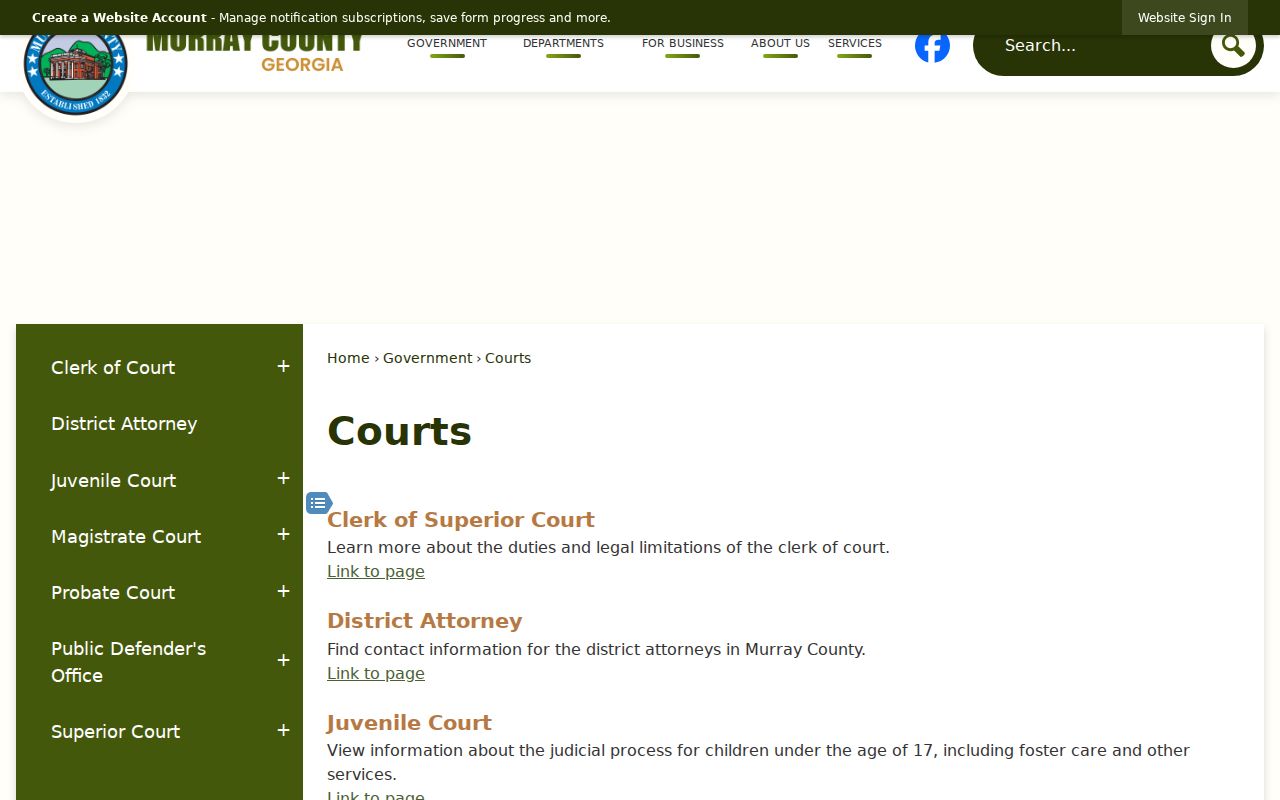
Some papers say Murray County but never name the right clerk. In that situation, check the directory first.
Routing rule: the Superior Court Clerk is not a universal custodian for Probate, Magistrate, Juvenile, Chatsworth, or Eton records.
What a Court Docket Shows
A docket is a chronological index of case activity. It may list the court, case number, case style, and filing date. Judge, public parties, attorneys, filings, hearing settings, and the outcome may appear as well. One catch: a docket line often names a document without showing its full text. The exact terms of a pleading, motion, or order can matter. Then you have to read the document itself.
| Case number | The court-assigned identifier, including any year, court code, or suffix. |
|---|---|
| Case style | The abbreviated caption used by the clerk to identify the parties. |
| Docket event | A dated filing, notice, court action, or recorded result. |
| Setting | A scheduled hearing event, not necessarily a trial or final outcome. |
| Status | A broad case label that should be read with the latest entries. |
| Disposition | The recorded way a count or case concluded. |
A filing is a request, never a ruling. An allegation is not proof. An open status is not a finding, and a calendar label tells you nothing about what happened at the hearing. For official or certified copies, go to the clerk that holds the Murray County court record.
PeachCourt Is an Account Route
Georgia Courts E-Access points Murray Superior Court searches to PeachCourt. The public screens show email and password fields. Registration, password recovery, and account creation for attorney and non-attorney users appear too. A direct search address leads only to a login. So anonymous search fields, result columns, coverage dates, wildcard rules, and a public refresh schedule stay hidden. They appear only after you register. PeachCourt is also the mandatory e-filing provider for Murray Superior Court. Filing and public access are related acts. They are not the same act. The vendor transmits and displays authorized information. Donna Flood's office remains the official custodian of the record. Registering does not promise that every image is free or open to the public.
| Public control | What it establishes | What it does not establish |
|---|---|---|
| Email and password | Account sign-in | Anonymous access |
| Register | Account creation route | Access to every file |
| Court selection | Murray Superior routing | Probate or city coverage |
| Provider link | Officially directed service | Clerk certification |
Which Courts Keep Dockets
Georgia recognizes six trial-court classes. Murray County's directory lists no State Court office. The local lineup runs Superior, Magistrate, Probate, and Juvenile. Two municipal courts round out the county's full trial-court lineup as well. The Superior Court of the Conasauga Judicial Circuit is shared with Whitfield County. Federal matters for Murray County land in the Northern District of Georgia's Rome Division. Those cases run on federal systems, not the county docket.
| Court | Docket covers | Where to search |
|---|---|---|
| Superior Court | Felony, civil, domestic, title, equity, and appeals | Georgia E-Access to PeachCourt or Superior Clerk |
| Magistrate Court | Claims to $15,000, dispossessory, garnishment, and warrants | Magistrate office and forms |
| Probate Court | Estates, guardianships, licenses, and county traffic | Probate office and traffic page |
| Juvenile Court | Dependency, delinquency, CHINS, and juvenile traffic | Restricted clerk process |
| Municipal courts | Eligible city traffic and ordinance cases | Chatsworth or Eton clerk and vendor |
The Georgia court navigation page explains the statewide hierarchy.
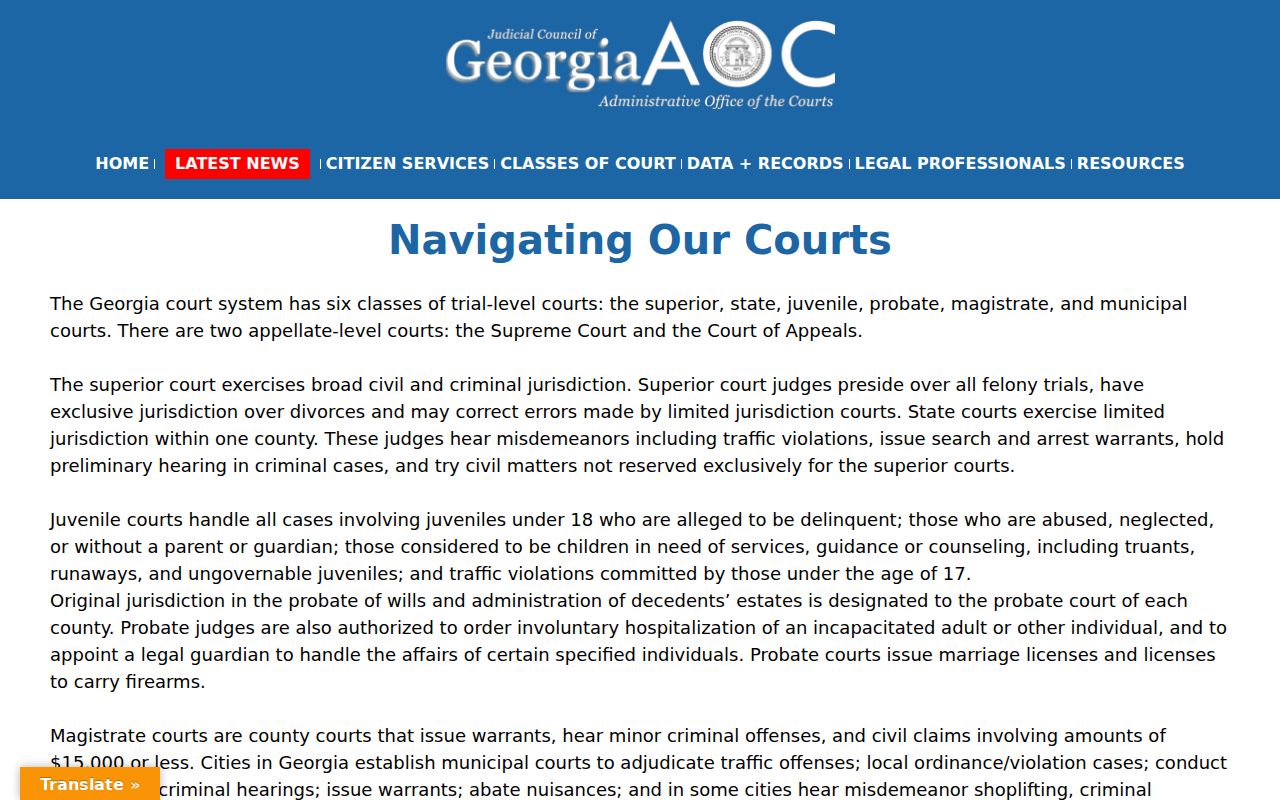
A statewide chart gives useful context. Only the local directory shows which Murray County offices actually exist.
The Conasauga Circuit Connection
Murray and Whitfield counties share the Conasauga Judicial Circuit. The official Superior Court page describes the court's general jurisdiction and its circuit role.
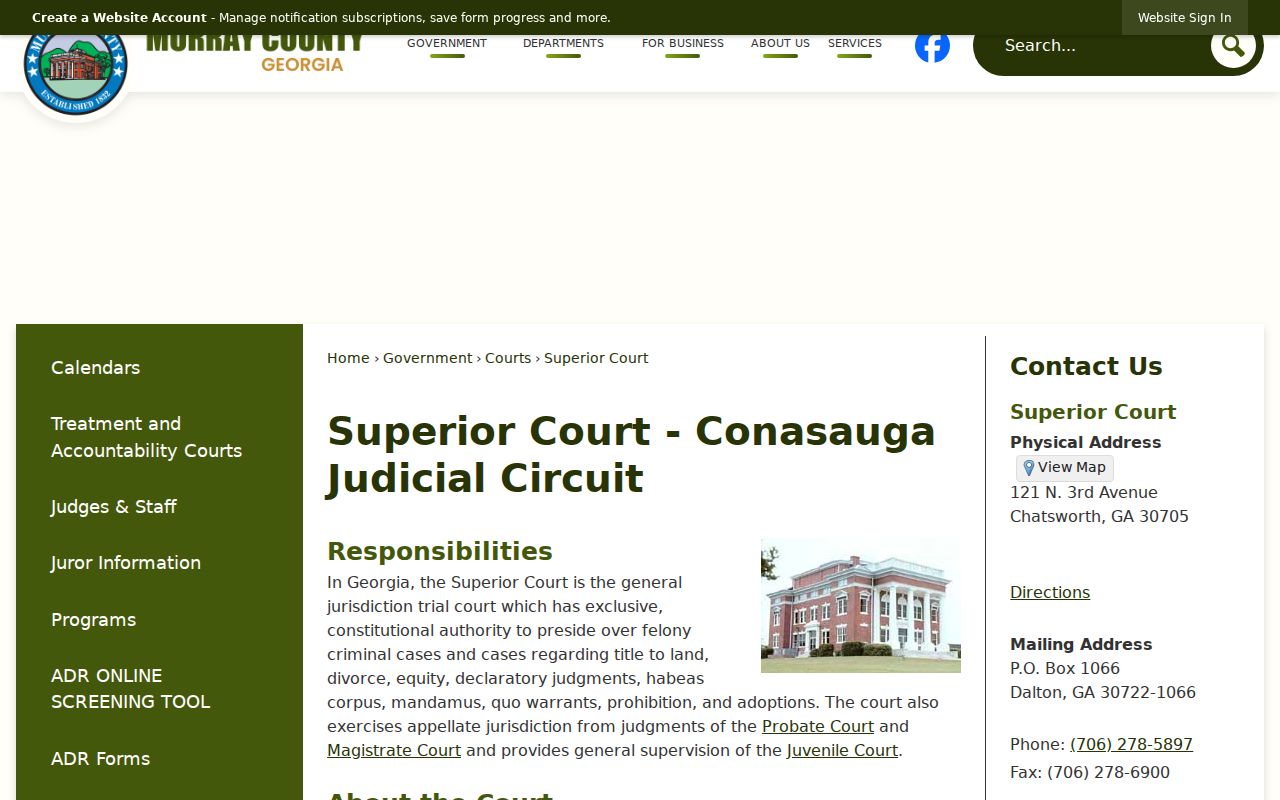
The circuit spans two counties. A circuit calendar or workload report can mix them together. The official 2025 workload assessment lists four Superior Court judges. It also gives circuit-wide three-year averages: 4,040 criminal defendants and 2,668 civil matters. Keep the math in mind. Those figures cover Murray plus Whitfield, never Murray County alone.
Caseload data, calendar settings, and pending dockets measure different things. None replaces a current case search.
Finding Court Dates and Settings
For current Superior scheduling, use the official 2026 Conasauga Master Calendar PDF. It runs on judge columns, with an M or W marker flagging Murray or Whitfield. The labels cover a range of settings. They include arraignments, criminal calendar calls, criminal non-jury settings, civil pretrials, civil jury trials, domestic matters, TPO calendars, and accountability-court events. Treat it as a planning calendar. It is not a searchable case docket. Always find the newest notice first. Compare its county, judge, and setting type against the latest docket entry and the calendar. If a deadline, an appearance, or a road trip rides on the date, call the clerk or court administrator. A reset can leave an old setting sitting in the case history. Severe weather, a continuance, or a new order may supersede an earlier date. The full Murray County court calendar workflow covers the M/W legend. It also explains local confirmation routes. Anyone hoping to postpone a hearing should not assume a phone call moved it. Murray County's FAQ says the person must appear on the original date. Added written involvement from a bonding agent applies when bonded. All of this stays subject to confirmation for the particular court.
Calendar Labels Are Not Outcomes
Labels like Criminal Non-Jury, Domestic, TPO, DV Court, MHC, and Drug Court describe a calendar or program. They establish nothing else. Not a charge, a diagnosis, a finding, a plea, or a disposition. The Conasauga circuit runs Drug Court, Domestic Violence Court, and Mental Health Court. But the courts publish no participant roster. They also offer no separate searchable treatment docket. The Treatment and Accountability Courts page identifies the circuit programs.
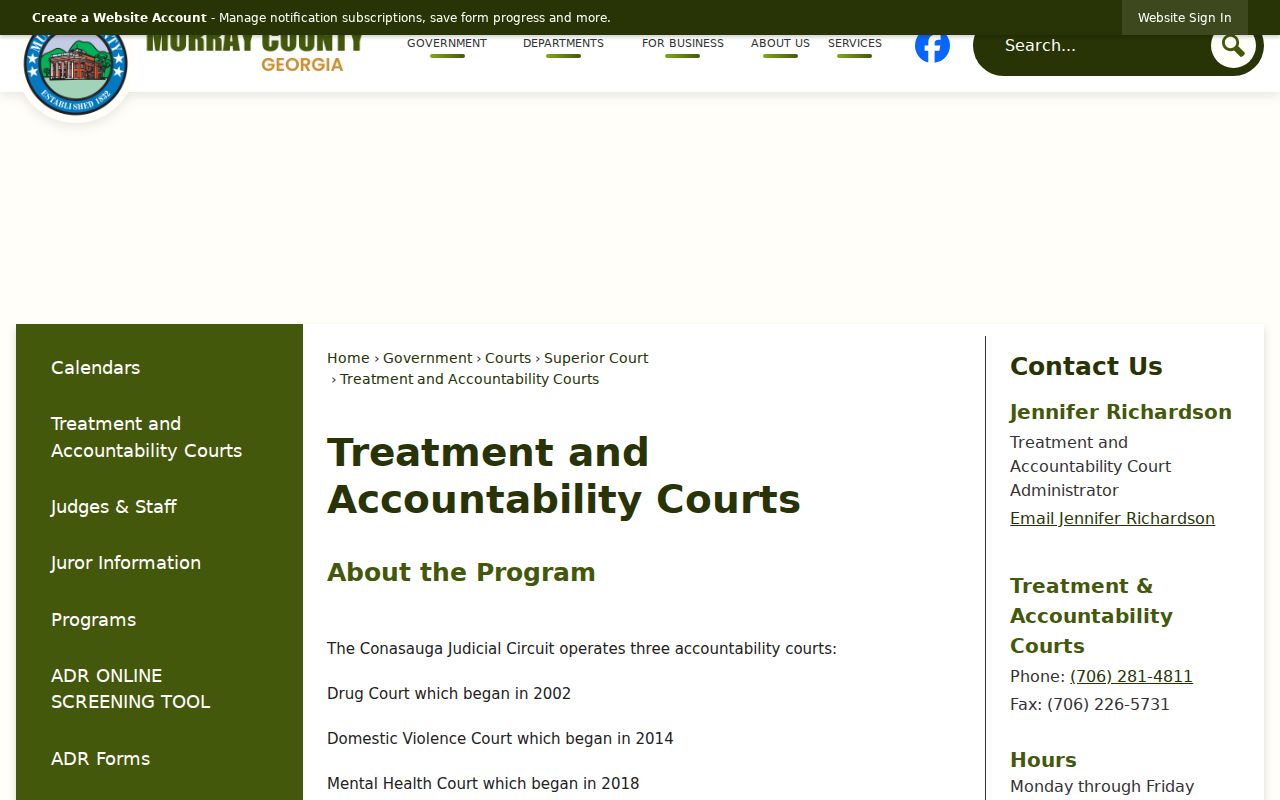
Use a program label only to read the published schedule. Case-level facts come from the right docket and the accessible filed records.
- Arraignment
- A setting for charges and a plea, not a disposition by itself.
- Calendar call
- A session used to organize cases and readiness.
- Continuance
- A court-approved move to a later setting.
- Disposition
- The recorded result of a count or case.
Public Access to Dockets
Plenty of Murray County court records sit open to the public. The openness has limits, though. Georgia's ordinary open-records framework governs covered agency records. Court files answer as well to statutes, court rules, and judicial orders. So one docket line may be public while an attached exhibit stays sealed, identifiers stay redacted, or electronic access stays restricted.
Access framework:
O.C.G.A. § 50-18-70 et seq. governs Georgia public-agency records and supports precise written requests.
Uniform Superior Court Rule 21 addresses access, sealing, and protected material in Superior Court files.
O.C.G.A. § 35-3-37 provides eligible criminal-history restriction procedures, not automatic erasure of every court record.
Georgia juvenile law restricts juvenile-file access, subject to defined exceptions and court orders.
Access denied? Ask the clerk to cite the rule. The statute, exemption, or sealing order behind a redaction is fair to request. What staff cannot do is build a report that was never created in the first place.
Juvenile Records Follow a Restricted Path
Murray County Juvenile Court hears dependency, delinquency, CHINS, and juvenile traffic cases. Those files follow a restricted path. JDEX, for instance, is an exchange for authorized users. It is not a public docket search or a repository of certified documents. A PeachCourt link elsewhere in the court system does not open juvenile material. The official Juvenile Court page shows the route through the local office.
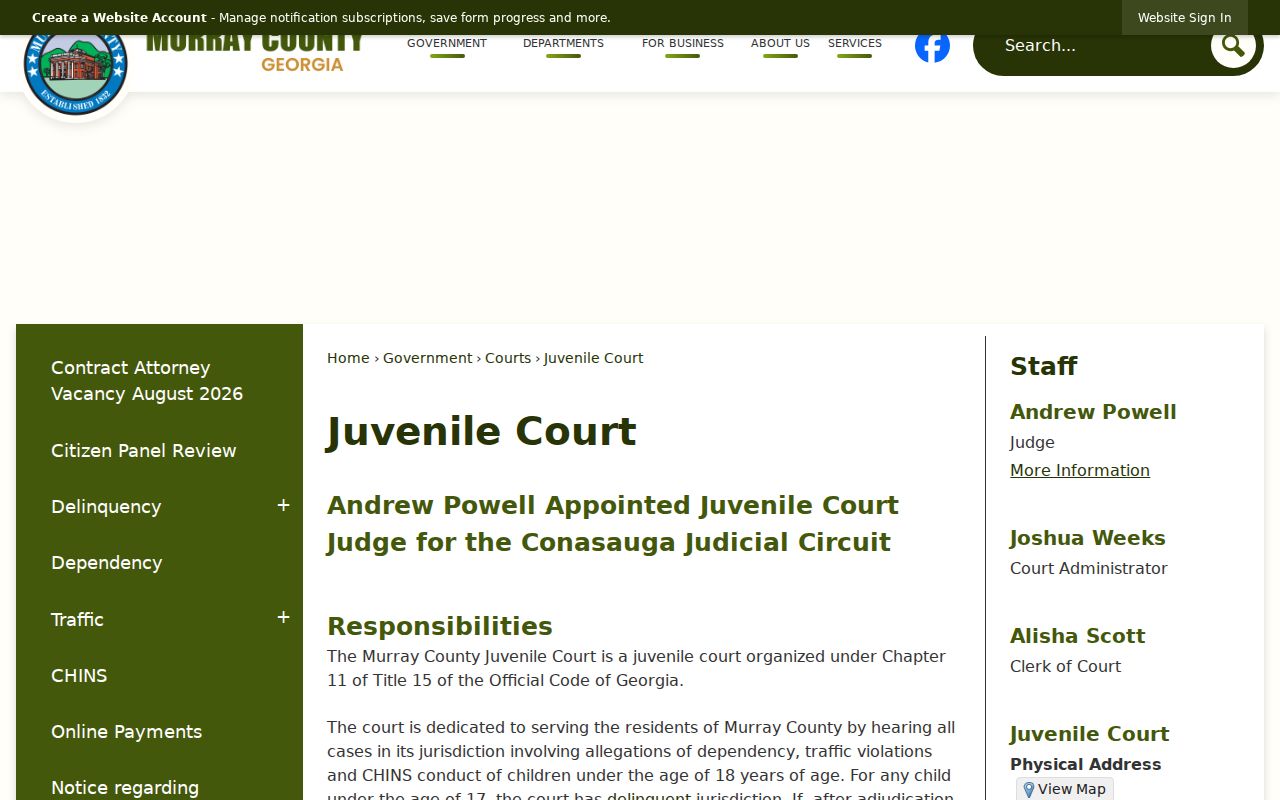
For the access procedure, contact the Juvenile clerk at 121 North Fourth Avenue in Chatsworth. The office lists 706-517-1400 extension 9 or 706-695-5828. Weekday hours run 8:00 a.m. to 5:00 p.m. Expect to be asked for identification, authorization, or a court order. Anonymous online access is not how this court works.
The Clerk and Docket Records
Donna Flood serves as Murray County Clerk of Superior Court. Her office files, indexes, retains, and certifies Superior Court civil, domestic, criminal, and appellate records. Recording, liens, plats, UCC work, and jury administration also pass through the office. A land index, however, is not a civil or criminal docket. Staff will explain process and fees. But they cannot pick a legal strategy or interpret a filing for you.
Donna Flood, Clerk of Superior Court
121 North Third Avenue
Chatsworth, GA 30705
706-695-2932
Monday through Friday, 8:30 a.m. to 5:00 p.m.
The official Clerk page describes the office and contact route.
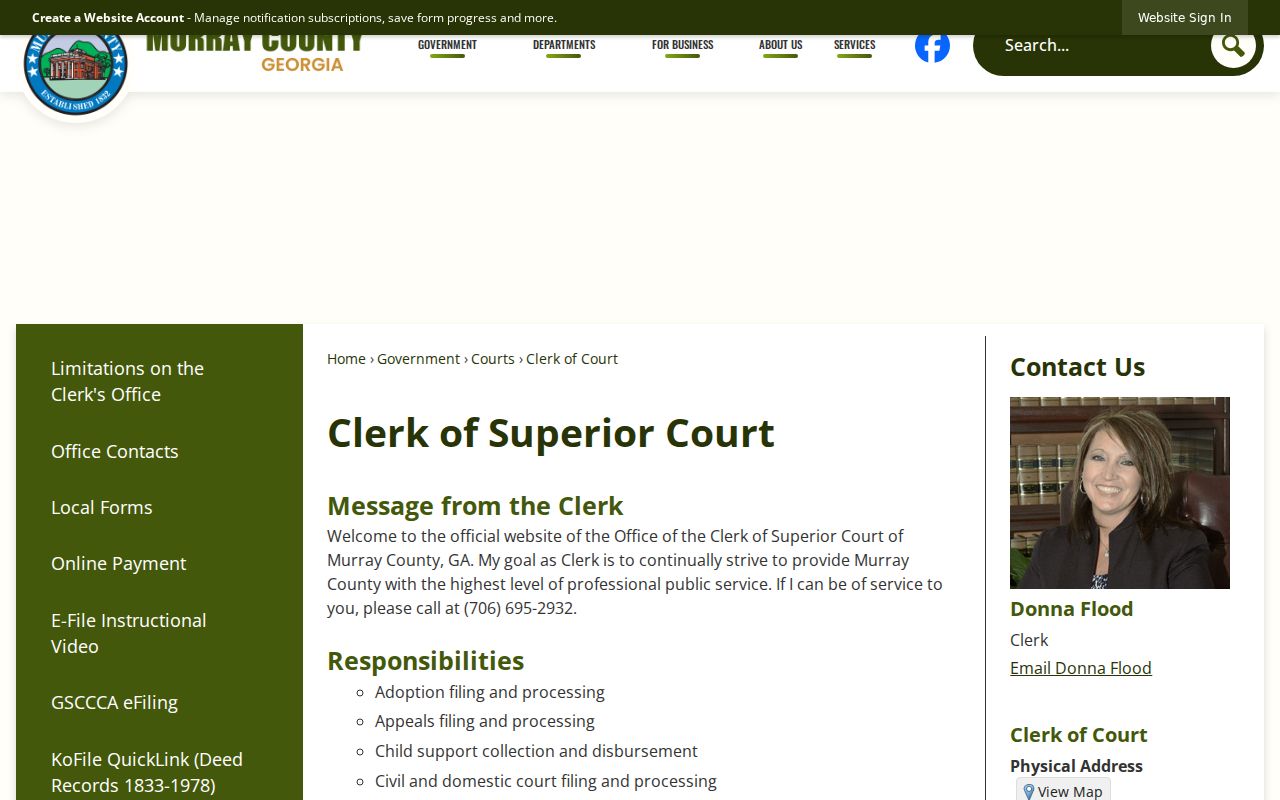
Call before you drive over. Confirm the building, file availability, copy method, payment type, and any accommodation you need. The county publishes no detailed public-terminal, parking, or security policy for every court building, so a quick phone check saves the trip.
Copies, Certification, and Separate Indexes
A plain copy just reproduces a public document. A certified copy adds the clerk's authentication. For certification, Murray County links to GSCCCA eCertification, a workflow that runs from account access through county and document selection, clerk processing, payment authorization, and delivery by secured PDF link; no current exact eCertification fee is posted, so request a quote before paying.
GSCCCA eFile handles real-estate recording, and Kofile supplies current and historic deed, lien, and plat indexes. Handy for property research, yes. Neither tool shows a Superior civil or criminal docket. Kofile's historic index books reach back to 1833, a sign of Murray County's long courthouse record history, yet an old property index is still not a case chronology.
The Murray County staff directory helps route requests among court offices.
Give the clerk the essentials up front. Name the court, the full case number, the case style, the precise document title and date, the copy type you want, and your return contact information.
Probate and Magistrate Need Separate Requests
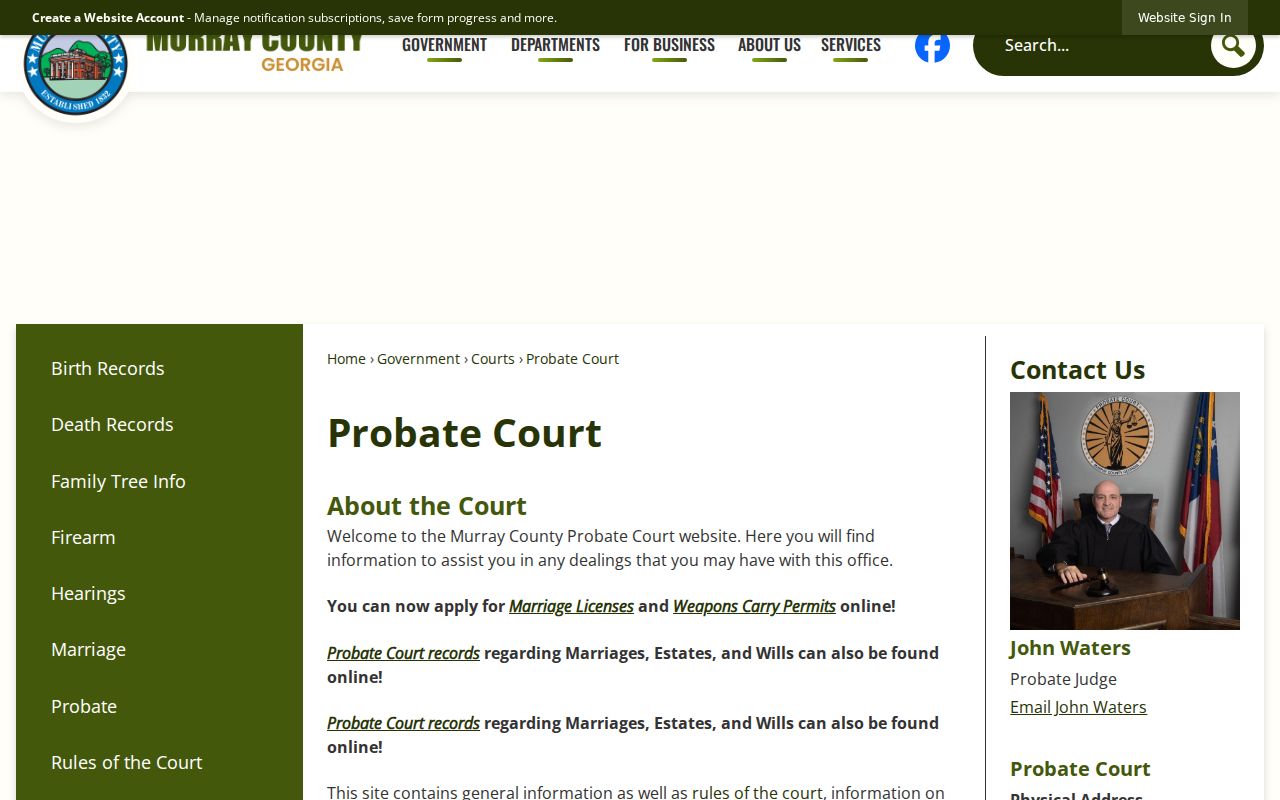
Probate Court sits at 115 West Fort Street. It handles wills, estates, guardianships, marriage licenses, weapons permits, and county traffic. Its traffic page lays out citations issued by named county and state agencies. It also covers payment, arraignment, contest, and failure-to-appear procedures. Remember, a Probate ticket will not turn up in a Superior case search. The Murray County Probate Court page gives its official record route.
Magistrate Court, at 812 G.I. Maddox Parkway, maintains minor civil, dispossessory, garnishment, personal-property, and warrant matters. Its published forms and fee schedule help you identify a filing, but a blank form is not a filed docket. Magistrate answers at 706-695-3021 and Probate at 706-695-3812.
Murray Courthouse Records Through Time
Murray County dates to 1832. Spring Place hosted the first court session in 1833, and a brick courthouse rose there in 1886. Chatsworth took over as county seat in 1913, and workers began the present historic courthouse in 1916, occupying it in 1917. That timeline explains why old files, land indexes, and current court functions can take different storage and access paths.
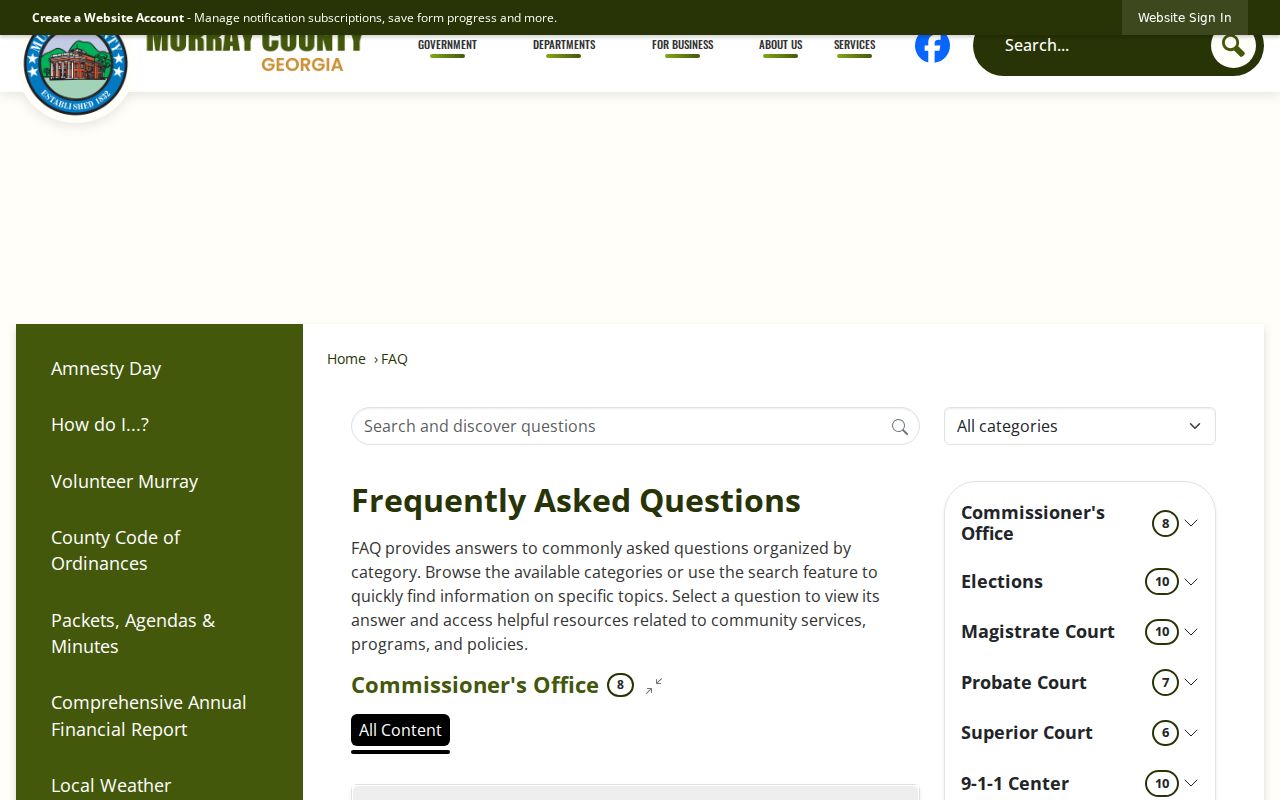
Modern tools layer onto this courthouse system. PeachCourt serves Superior e-filing and account-based access. GSCCCA eCertification offers an electronic certified-copy route. Probate and the two cities each run separate traffic tools, and Georgia states plainly that no centralized traffic citation database exists. The official county FAQ provides practical local court routing.
One rule has never changed. Identify the office that created or maintains the record before you pick a portal or request method.
Court Dockets by City in Murray County
Two incorporated cities appear in Murray County's official 2020 planning figures. Chatsworth counts 4,874 residents. Eton counts 824. Each municipal court runs its own route for eligible traffic and ordinance matters. So a city citation lookup is not the full county court docket. Nor does a city ticket automatically become a Murray Probate case.
Chatsworth Court Docket
Government Window provides the city-linked traffic-ticket route. Confirm a missing citation or court date with the city clerk at 706-695-2834.
Eton Court Docket
EZCourtPay uses date of birth plus citation number or last name. Confirm current payment and appearance rules with Eton City Hall at 706-695-2652.
Read the issuing court on your citation before paying or searching. Georgia advises allowing 7 to 21 business days for a new citation to reach a vendor. If a municipal matter transfers, keep the city citation number and obtain the receiving county case number, so both docket histories stay traceable.
Two Cities, Two Citation Routes
Chatsworth sends its tickets through a Government Window page tied to the city. It shows a Traffic Tickets option and a court clerk contact. Beyond that, the clerk posts no full field list and no complete municipal calendar. So skip any guesswork about what a required field might be. If the vendor cannot pull up your citation, call the city clerk. Let that office sort it out.
Eton runs its own pay-fines page with a link to EZCourtPay. The form asks for your date of birth. It also wants either a citation number or a last name. One wrinkle: Eton's current citation instructions and an older procedures PDF disagree about paying by phone. Confirm before you act. And remember that the citation itself controls whether an appearance is mandatory.
Need a phone number for either city? The official Murray County courts directory links both municipal offices. Keep these routes separate from Donna Flood's Superior Court records. Murray Probate traffic records live on their own dockets too.
Map and Directions to the Murray County Courthouse
Superior Court civil, domestic, criminal, and appellate files are kept at the Murray County Courthouse, 121 North Third Avenue in Chatsworth, a two-story brick building begun in 1916 and occupied in 1917. Clerk of Superior Court Donna Flood's office handles filing, recording, liens, plats, UCC, and jury administration from this address. Juvenile Court keeps a separate office nearby on North Fourth Avenue.
Donna Flood, Clerk of Superior Court
121 North Third Avenue
Chatsworth, GA 30705
706-695-2932
Monday through Friday, 8:30 a.m. to 5:00 p.m.
The county has not published a courthouse parking map, public-terminal policy, or a detailed accessibility or security-screening statement, so call ahead to confirm what to expect on arrival. Probate, Magistrate, and Juvenile matters are handled at separate Chatsworth addresses, not this courthouse.